


REAL STORIES. NEW LAYERS OF MEANING.
A true story told in 9 short field notes.
10-minute read.

──── FIELD NOTE 1 of 8
Great Facilitation. Unwanted Patterns.

“Why don’t we go around the room and share our thoughts?”
Everyone breathed a sigh of relief. I winced.
Keiko was doing what a good facilitator is taught to do – keep it balanced. Include everyone. Exude warm, welcoming energy. No opinion is unwelcome when Keiko is in charge.
Yet the words coming out of her mouth were not what I was paying attention to. It felt less like a group working on a project than a group waiting for Keiko to enthusiastically decide what should happen next.
A true discussion never really occurred. When the room became quiet, and it frequently did, Keiko was always 3 seconds away from getting things moving again.
Her words were kind, her heart was filled with longing for others to reach their potential.
So it was perplexing that Keiko could not see the pattern that, to me, was clear as day:
When the room goes silent, Keiko saves the discussion. When Keiko saves the discussion, everyone else becomes more attuned to what Keiko is doing, leaving their own critical thinking unattended.
What was even more baffling to me was the smiles radiating from her team members. They expressed sincere gratitude when Keiko got things moving, when she complimented people, encouraged them to share their thoughts, thanked them for the amazing opinions and great questions.
You could technically label this interaction a discussion. But I wouldn’t.
I was witnessing a pattern of saving and waiting, and this habit was already becoming comfortable for the group. This pattern was likely to play out in their next project, and the next one, for months or years to come.
Keiko was a great facilitator.
She was also contributing to a pattern she definitely didn’t want.
Okay, let’s see what happens when I change the rules.
“Sorry to interrupt. Keiko, please let people choose when to speak on their own.”
I watched Keiko’s face closely. I wanted to know how the request had landed. She did not look angry. She looked genuinely bewildered, as though I had just asked her to stand beside someone in trouble and refuse to help.
Keiko was not angry, she was hurt. She stammered out, “But I’m just trying to help … is that wrong?”
No, helping is not wrong. But theft is.
Every person eventually reaches moments they don't want to face. Speaking up is one of them. Remaining silent is another. In those moments, they have to choose. When someone voluntarily chooses to face what they fear, they grow. When we make that choice for them, something important is lost.
Keiko could make speaking easier. What she could not do was make that choice happen inside someone else’s mind.
The important moment isn't always when someone speaks.
Sometimes it happens a few seconds earlier, when they quietly decide, "Okay... my turn."

──── FIELD NOTE 2 of 8
My Turn.

──── FIELD NOTE 3 of 8
30 seconds?

What happened when the group followed the new rule and allowed each person to choose when to speak?
Exactly what you would expect. Nothing. Just longer silences.
But Keiko stopped filling them. Hesitantly, others began breaking them. The group was not deciding who would speak next, they weren’t waiting for one person to speak next, and they weren’t taking turns. The room no longer had a designated starter. If the discussion was going to move, someone had to decide to move it.
One silence was broken with an interesting question, “Okay, I am curious – how long of a silence is ‘too long’, for you personally? And why?”
Everyone instinctively looked up, trying to imagine at what point they would become frustrated by silence.
There were 12 people that day, and 12 different perspectives came out.
“2 seconds feels long to me … I start worrying about finishing the meeting on time if this keeps up.”
“10 seconds is fine for me … I usually need a few seconds to organize my thoughts.”
“30 seconds is no problem for me. I worry that half-formed thoughts might end up wasting more time.”
It turns out, no one had the same internal criteria. But the answers made people laugh and ask further questions.
People’s comments morphed from “This is what silence means to me …” to “Oh, this is what silence means to you, and you, and you.”
When the dialogue faded, another silence arrived. This time, nobody rushed to escape it.
Silence, no longer an unbearable weight, was not immediately filled by Keiko. More and more, others began to fill that silence.
Ironically, the group had dramatically fewer long silences after that.
Assuming you do not gnaw them every day, how do you know when it is time to cut your fingernails?
You probably do not measure them. At some point, touching things simply begins to feel wrong, and you reach for the clippers. Afterwards, you forget about your nails until they demand your attention again.
Within a couple of weeks, most people had forgotten the program’s specific topics beyond the broad outlines. Real work returned, along with deadlines, meetings, problems, and everything else capable of crowding out their good intentions.
Nothing dramatic announced that the team was changing.
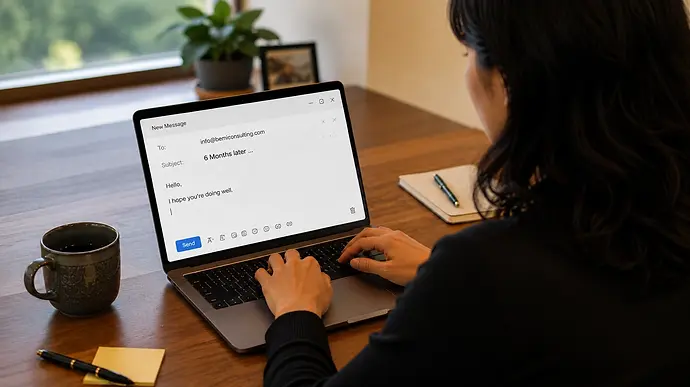
Six months after we finished working together, Keiko sent me an email. She had been thinking about the team’s direction after their current project when Taro’s voice interrupted her concentration. The group had identified a problem, and Taro was telling the others that he would take the lead on it.
Keiko’s mouth nearly opened in surprise, but she quickly stopped herself.
Taro had usually waited for work to be assigned. This time, nobody had called on him, encouraged him, or asked who would volunteer. He had seen something that needed doing and put himself forward.
Only then did Keiko begin thinking back over the previous months. Taro’s decision was not an isolated surprise. Other people had been asking more questions, offering ideas earlier, and taking responsibility without waiting for her to keep things moving.
There had been no clear day when the team became more independent. Keiko could not point to a meeting and say, “That was when everything changed.”
She had simply looked up one day and realized that she was no longer responsible for starting everything or keeping a good conversation going.
──── FIELD NOTE 4 of 8
Just as I expected. No Change.
──── FIELD NOTE 5 of 8
Wait … should I say that?

Keep it Specific
"My goodness... that's pretty gross."
"Should I tell him?"
Finding it increasingly difficult to concentrate, you keep staring at the mustard in the corner of your boss's mouth while he enthusiastically explains today's agenda.
When thoughts appear, a battle begins. Sometimes it's over in a fraction of a second. Sometimes it lasts a lot longer.
Do I say what just popped into my head... or not?
Meetings are strange places. On the surface they look like an orderly procession of comments and questions. Underneath, thousands of private thoughts are competing for release, each person quietly deciding which ones deserve to enter the discussion.
Six months earlier, Taro's internal bouncer had been rejecting almost everything before it reached the door. It was convinced that silence was usually the safer choice.
Today, Taro's bouncer had become more discriminating. Not every thought had to be brilliant. Not every question had to be guaranteed to succeed.
Keiko's bouncer, meanwhile, had been learning the opposite lesson. For years it had waved almost every helpful thought straight through. It was beginning to realize that some thoughts were better left waiting outside for a while, or abandoned entirely.
Neither of them became different people overnight.
They simply became a little better at deciding which thoughts to share—and which ones to keep to themselves.
We rarely discussed how to decide which thoughts should stay in or come out. That quickly becomes endless theorizing because there is no reliable way to predict how people will react every time we speak. We speak and deal with what follows, or stay silent and deal with what follows.
We also had to let go of the mirage of becoming fearless. If you're waiting for fear to evaporate before you speak, you might as well sew some duct tape over your lips.
Instead, we became interested in the stories people told themselves about what had happened.
At first, Taro believed he stayed silent because he was trying to be polite. It sounded reasonable. But the more we revisited that moment, the less that explanation seemed to fit.
What kept resurfacing was something much less flattering: he was worried that one unnecessary question would waste everyone's time and irritate the group.
Imagine spending months learning how to speak more politely, when the real struggle is believing that anything you say might run out the clock and ruin everyone's day.
Once Taro saw that more clearly, the conversation changed. We stopped asking how to eliminate fear and started asking a different question.
"Let's assume your question really did waste everyone's time. Worse, everyone in the room looked annoyed. What do you do now?"
Avoiding mistakes sounds wonderful in theory.
But if you have no way to recover from the ones that inevitably slip through, your current habits will be the only thing you can find when discomfort strikes.
──── FIELD NOTE 6 of 8
Is that true?

──── FIELD NOTE 7 of 8
Are you seriously trying to measure that?


I have an idea.
Let's put a tiny microscope inside Taro's head. We'll wait for one of those little thoughts to appear.
"Maybe I should ask..."
We'll watch it hesitate for a second or two before deciding whether to come out into the room or disappear again. Then we'll count. How many thoughts escaped? How many stayed hidden? How many almost made it?
Putting aside the ethical problems with implanting employees with monitoring devices, I don't know of another way to measure that process directly.
Yet that was precisely where the biggest changes seemed to happen. Keiko didn't need a microscope to know something had changed.
She watched Taro volunteer to explain to the American team why the proposed schedule wouldn't work in Japan. She watched him ask a question that redirected an entire discussion. She watched him ask a rather naïve question, pause, recover, and then ask a much better question a few seconds later.
None of those moments, on their own, proved anything. Together, they painted a remarkably clear picture.
Every large company I work with eventually asks how success should be measured. I understand why. But there is a problem. The most important moment in this story cannot be measured.
We can count how many times Taro speaks. We cannot know how many thoughts he kept to himself, or why he chose to voice one thought instead of another.
Those decisions happen inside a black box. By the time we hear the words, the interesting part is already over.
Stories, however, are remarkably good at capturing those invisible moments. Keiko's email told me far more than a survey ever could. It didn't provide a score. It provided indicators of change. Taro had begun making choices he hadn't been making before, and Keiko had become the kind of leader who could resist the temptation to choose for him.
Many important things can be measured. Many important human things cannot. I've never found the inability to measure something particularly convincing evidence that it isn't worth developing.

For months, Keiko had spent much of her attention keeping discussions alive: deciding who to encourage, who to invite in, and how to lift the energy whenever it dipped.
With so much of her attention fixed on the team's next few seconds, she rarely had the space to think about the people the team was trying to serve.
Now she noticed herself doing something she hadn't done recently.
While Taro and the others wrestled with the next challenge, Keiko found herself thinking about the customer waiting at the end of the project.
──── FIELD NOTE 8 of 8
New Layers of Possibility



──── The Right Fit?

BEMi CEO
James Chappell
I'm curious. What thoughts came to mind as you read this story?
Perhaps you recognized someone you work with. Perhaps you recognized yourself. Or perhaps a familiar situation now looks slightly different.
Every company has its own Keiko. Every team has its own version of this story. The details are different. The questions usually aren't.
If this story gave you a clearer way of seeing the people around you—and yourself—you may be wondering what else becomes easier to notice when people are given the time and structure to look carefully.
I also understand that work like this has to fit within the realities of an organization. You may need to classify it as leadership training, team development, communication training, coaching, or an organizational-development initiative.
You may need a proposal with objectives, session outlines, expected outcomes, and practical details that can be shared internally.
That's perfectly reasonable.
Those practical requirements don't change how I work. They simply provide the structure that allows the work to happen.
Every engagement is designed around the people in front of us, while still fitting comfortably within the planning, budgeting, and approval processes your organization already uses.
If you'd like to see what that looks like, I've included an example below showing how the story you've just read could be presented as a leadership development proposal.

If this helped make sense of what you've been seeing
If this approach puts words to something you have already been noticing, there's a good chance we'll work well together.


At BEMi, we provide training to build teams that can speak up with confidence. We tailor our programs to offer the best solutions for each company. Please feel free to contact us to get started!


