


Inside a BEMi Session
The underlying aim is simple: people become more able to choose how they respond, rather than waiting for someone else to move first.
This is one example of how that journey begins.
There is no preparation and no homework.
After a brief introduction, I ask the group to follow one guideline: choose your own moment to speak, and leave others free to choose theirs.
Then the slides begin. I offer no explanation or interruption. It works equally well online or in the room. The unexpected does the rest.

──── WHAT PARTICIPANTS SEE
Example Session: slide 1


──── BENEATH THE SURFACE
What are we supposed to do?
The group rarely expects this kind of project. The first reaction is usually silence and nervous eye contact.
There are no detailed instructions and no obvious goal. The only way forward is to begin sharing what people are actually thinking—even if they're unsure.
This is intentional.
One of the hardest things in business is responding when there isn't a script. Rather than practising prepared answers, the group begins by experiencing an unexpected situation together.
The image itself never contains an answer. It contains a question. As the group works through it, their own habits begin to appear: who waits, who leads, who searches for certainty, and who is willing to think out loud.
Those patterns often become just as important as the topic itself.
──── WHAT PARTICIPANTS SEE
Example Session: slide 2

──── BENEATH THE SURFACE
Guessing out loud
Some members find it surprisingly difficult to guess out loud.
Yet in real work, we often have to respond before we have complete certainty.
That is why the projects are intentionally designed without hinting at a "correct" answer. Everyone sees the same image, but no one knows exactly what it means.
As people begin offering tentative ideas, the group discovers that different interpretations are not a problem to eliminate—they are the raw material for dialogue.
Just as importantly, I begin learning how this particular group thinks.
Their responses help shape where the session goes next.
──── WHAT PARTICIPANTS SEE
Example Session: slide 3

──── BENEATH THE SURFACE
Wait ... there's another way to see it?
When the next slide appears, groups often laugh and say, “Oh… we got it wrong.”
I don’t interrupt. That reaction is valuable.
Nothing has actually been marked right or wrong. The group has simply discovered another way to frame the same topic.
People often assume an idea must be either good or bad. Many are genuinely surprised by the suggestion that there could be too much psychological safety.
But after a moment’s reflection, they usually begin to see situations where that might be true.
This is an important shift. The group is no longer replacing one “correct” answer with another.
They are beginning to experience how a different perspective can change the whole meaning of what they thought they understood.
──── WHAT PARTICIPANTS SEE
Example Session: slide 4
──── BENEATH THE SURFACE
This changes what we thought we were looking at
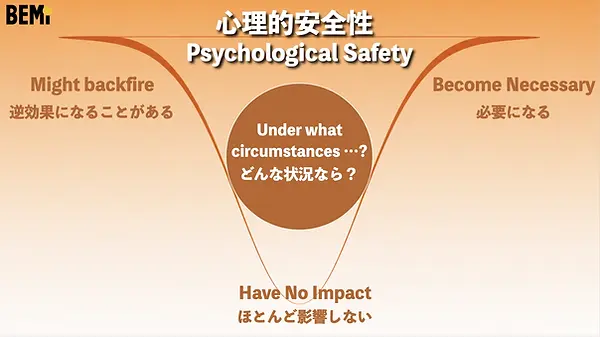
The next slide does more than add another interpretation. It reveals that the same idea can operate very differently depending on the situation.
Psychological safety may help, have little effect, or even create new problems. The difference lies in context.
This is where the thinking becomes more demanding—and more useful.
The group is no longer asking only, “Is psychological safety good?” They begin asking: In this situation, for these people, doing this kind of work, what effect might it actually have?
These additional perspectives can change the group’s whole understanding of the topic. The aim is not complexity for its own sake. It is to notice distinctions that affect judgment, decisions, and the way people work.
Sometimes the group reaches a meaningful question I had not anticipated. That is not a detour. It shows that they are beginning to generate useful perspectives of their own.
Occasionally, someone tries to help a quieter participant by asking, “What do you think?”
This is one of the few moments when I may step in—not to direct the discussion, but to protect each person’s right to choose their own timing.
──── WHAT PARTICIPANTS SEE
Example Session: slide 5

──── BENEATH THE SURFACE
Finally, some guidance!
Only after the group has experienced the topic from several different angles do I begin asking more direct reflection questions.
Notice the order. The reflection comes after the experience, not before it.
Rather than explaining psychological safety and asking whether people understand, the group first experiences uncertainty, multiple interpretations, changing perspectives, and dialogue for themselves.
The discussion is no longer only about psychological safety.
It is also about how their own thinking changed as the situation unfolded.
Across several sessions, these experiences begin to shape how people respond to later unexpected projects.
Over time, the same changes begin to appear in real work: in how they interpret situations, choose when to speak, respond to uncertainty, and act without waiting for someone else to move first.

If this way of working makes sense to you
If this helped you see more clearly what may be happening in your team—and you can sense the value of development that unfolds this way—there’s a very good chance we’ll work well together.


At BEMi, we provide training to build teams that can speak up with confidence. We tailor our programs to offer the best solutions for each company. Please feel free to contact us to get started!


